
New data. A clearer map.
Orphan wells, now in focus
Find mapped orphan wells across Alberta, Texas, Oklahoma and Mississippi with new data and the ORPHANED filter in Oilfield Route. Clear the clutter and plan your next site visit.
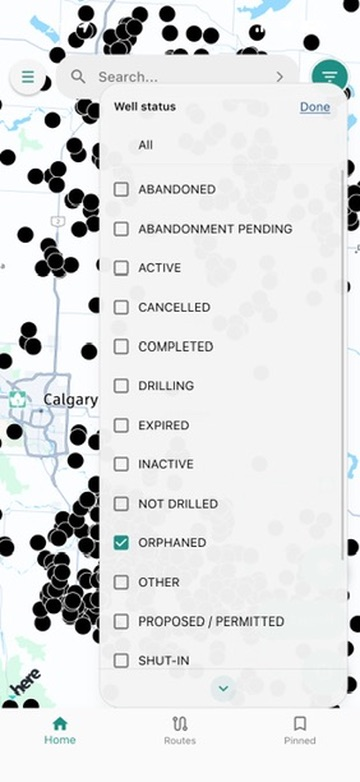
How to filter to orphan wells
- Open the map and tap the filter button at the top right, beside the search bar.
- Select ORPHANED and leave every other status unchecked. Scroll the list if needed; ORPHANED sits below NOT DRILLED.
- Tap Done. The map shows wells matching the selected status in the available data.
Select a displayed well to review its details and plan a route to it. For a run across several sites, use the multi-stop planning tools on Pro.
Well status filtering is included on Essential and Pro Subscriptions, on iOS and Android. Offline capabilities and multi-stop planning require Pro. Prepare your regional maps before leaving cell coverage.
Where orphan filtering is available
Orphan filtering covers Alberta, Texas, Oklahoma and Mississippi. Available well status data varies by region and depends on the source records integrated into Oilfield Route. Always check the relevant regulator's records when you need to confirm a site's designation or closure status.
What an orphan well actually is
In Alberta, abandoned means a well has been permanently sealed and taken out of service to the regulator's requirements. Remediation and reclamation may still be needed, and responsibility for the site continues. A well can be both abandoned and orphaned, with cleanup still outstanding. The AER's explanation of well states describes this distinction.
Orphaned concerns responsibility for a site. In Alberta, the AER may designate a site as orphaned when there is no financially viable or responsible owner. Once designated, the Orphan Well Association can take on its care and closure. A defunct operator alone does not establish orphan status; receivers or viable working interest partners may still be responsible. See the OWA's designation guidance.
Texas uses different criteria. The Railroad Commission of Texas defines orphaned wells as inactive, noncompliant wells that have been inactive for at least 12 months and whose responsible operator's Organizational Report (Form P-5) has been delinquent for more than 12 months. Those are Texas's criteria; other states have their own definitions.
Oilfield Route maps available source orphan designations into a common ORPHANED filter. The underlying criteria remain specific to each jurisdiction, so the label should be read alongside the regulator's definition.
In Alberta, OWA management and AER orphan designation are not interchangeable. The OWA's inventory scope includes both designated orphans and assets managed under Working Interest Participant Agreements (WIPA). Inclusion in an OWA list alone should not be treated as proof of orphan designation.
The scale of the work
These published figures describe different inventories and reporting periods. They provide context for field planning; they are not counts of the wells displayed in the app.
Alberta. The OWA's published inventory listed 7,370 wells requiring decommissioning when checked on September 15, 2026. OWA describes its overall inventory as including orphan and WIPA sites.
Texas. The RRC's July 2026 plugging report, issued August 10, reported 12,185 known orphaned wells in noncompliance with its plugging rule. Separately, it listed 3,418 approved wells remaining to be plugged, with an estimated remaining plugging cost of US$199.8 million. The approved backlog is a subset of the known orphan inventory, and its estimated cost is not the actual average cost of wells plugged that year.
Oklahoma. The OCC's January 27, 2025 report documented more than 20,000 wells on its Orphan Well and State Funds lists across 76 of 77 counties. Its illustrative cost table estimated US$574.6 million for plugging, excluding required methane testing costs under federal funding. The narrative and table use slightly different well totals, and the report also identified roughly 18,000 older wells still requiring investigation.
Mississippi. The Oil and Gas Board's FY 2026 budget and program narrative describes federal Infrastructure Investment and Jobs Act support for orphan well plugging and site restoration, including a five-year grant received in May 2024. Identifying and locating potentially orphaned wells remains part of that work.
Who this helps in the field
- Decommissioning and plugging contractors. Review the distribution of mapped wells when planning site visits or researching a work area. Confirm project assignments and bid requirements with the relevant closure program. The OWA engages prime contractors for packages of work, with subcontractors engaged through those contractors.
- Environmental and methane measurement teams. Use the map to organize assessments, reclamation visits, baseline surveys and field itineraries across several sites. Orphan status alone does not establish emissions levels or carbon-credit eligibility.
- Field crews and landowners. Review mapped well details before a visit, then confirm the current site contact, access arrangements and road conditions with the responsible organization or assigned contractor.
Orphan sites may have assigned contractors, inspections and ongoing monitoring. Confirm those arrangements before travelling, and follow your crew's check-in procedures.
Install it now and keep routing when the signal drops
Choose your device, download the regional map package for your operating area, and head out with offline routing ready before you lose coverage.
Tell us where you need orphan well coverage
Every regulator publishes its data differently. If your work needs orphan well data in another province, territory or state, tell us where you operate and what you would use it for.
Your feedback helps us prioritize new coverage. The contact page reaches our team directly, and you can also use the Support button in the app.
Review the core features, compare subscription options, or ask the team a question.